AI Agents as Cybernetic Organisms
Rubén Rodríguez Abril
This article proposes interpreting artificial intelligence agents as genuine cybernetic organisms—that is, as systems whose functional organization displays profound analogies with that of living beings. To this end, it examines the nature of agentic AI, defines the concept of the cybernetic organism and its characteristic properties, proposes a classification of machine autonomy into four functional levels, and finally examines autonomous drones as a technological paradigm capable of illustrating both the potential and the challenges posed by this new generation of machines.
The Emergence of Agentic AI
In recent years, within the field of artificial intelligence—and particularly Deep Learning—a new category of systems has emerged that can perceive their environment, make decisions, and act autonomously to achieve objectives. These systems are known as AI agents.
Unlike conventional Deep Learning systems—whose execution begins with input data and ends with an output—an agent maintains a continuous operating cycle: it perceives the state of its environment (through sensors or information sources), evaluates the situation, decides on an action, executes that action, and immediately begins the same process again. Its behaviour does not consist of an isolated inference, but of continuous interaction with the environment in which it operates.
Agentic AI has followed two largely independent lines of development that are now beginning to converge. The first originates in robotics and autonomous systems, where self-driving vehicles, drones, and mobile robots have for decades integrated perception, navigation, and real-time control. The second arises from large language models, whose evolution has enabled the emergence of agents capable of planning tasks, using tools, accessing persistent memories, and interacting with other systems with a relatively high degree of autonomy. Platforms such as Hermes belong to this second category.
By their nature, AI agents fall into two main types:
–Software agents—such as virtual assistants or chatbots—operate exclusively in the digital domain. They process information and make decisions within simulated or cloud-based environments. Their interaction with the physical world is indirect, through interfaces such as screens or communication systems.
–Hardware agents—such as autonomous robots—are designed to interact directly with the physical environment through sensors and actuators. Their behaviour is constrained by the laws of the real world—gravity, air resistance—and they require greater real-time processing capabilities to adapt to changing conditions.
Although their architectures differ, both types of agents share the same functional organization. A drone uses cameras, inertial sensors, and actuators to interact with the physical world; a software agent uses interfaces, tools, and digital information sources to operate within a virtual environment. In both cases, there is a continuous cycle of perception, decision, and action that enables them to adapt their behaviour to changing circumstances.
This convergence invites us to view autonomous agents from a different perspective. Rather than merely algorithms capable of performing specific tasks, they constitute a new class of systems whose organization resembles, in many respects, that of living organisms. Understanding this analogy is the purpose of the following section, where we introduce the concept of the cybernetic organism as a general framework for interpreting contemporary agentic AI.
The Cybernetic Organism
A cybernetic organism is an autonomous system capable of maintaining continuous interaction with its environment through mechanisms of feedback, homeostasis, adaptation, and structural coupling. Unlike a conventional machine, it does not simply execute a predefined sequence of operations, but continuously modifies its behaviour according to the information it receives from its environment and the consequences produced by its own actions. Autonomous vehicles, drones, mobile robots, and software agents are among the most representative examples of this new category of systems.
Its analogy with biological organisms lies in its functional organization. A cybernetic organism possesses neither neurons nor metabolism, but shares with living beings the same organizing principle: preserving its operability through continuous interaction with its environment. Its architecture incorporates mechanisms of self-regulation, adaptation, and learning that enable it to maintain its functional identity in the face of external disturbances. Rather than merely reacting mechanically to stimuli, it establishes continuous coupling with the world around it, so that its behaviour emerges from this interaction rather than solely from the execution of a previously established program.
Its organization presents five fundamental properties:
Autonomy. Once a general objective has been established, the agent decides for itself how to achieve it, without requiring external instructions for each of its actions.
Feedback. Behaviour is continuously adjusted using information from the environment. Each new observation makes it possible to correct deviations and adapt the agent’s behaviour to changing circumstances.
Functional homeostasis. Like living organisms, these systems preserve their stability in the face of external disturbances, continuously compensating for errors in order to maintain their operational capacity. This property is closely related to the previous one.
Structural coupling. Agent and environment evolve together. The system’s behaviour depends on the state of the environment, while its actions simultaneously modify that same environment, establishing a continuous cycle of reciprocal influence.
Internal representation. The most advanced cybernetic organisms do not react solely to the present state of their environment. Instead, through artificial intelligence models and data obtained from sensors (computer vision, SLAM, inertial navigation, etc.), they construct internal models on which to base their decisions, anticipating future events before acting.
The Four Levels of Machine Autonomy
Machine autonomy is not a uniform property, but the result of incorporating different functional capabilities. From this perspective, four levels of machine autonomy can be distinguished. These are neither mutually exclusive categories nor a strictly historical sequence, but functions that can coexist within the same system. The most advanced agents simultaneously integrate several of these levels, incorporating each new capability as a subsystem within an increasingly complex architecture.
Automatic System
An automatic or programmable system is one whose behaviour is completely determined by a pre-established sequence of operations executed without continuous human intervention. The machine performs exactly what it was designed to do, but lacks mechanisms enabling it to modify its behaviour according to the state of its environment. Its relationship with the world is essentially unidirectional: it receives a command, executes a program, and produces a result.
Programmable automatic systems have existed for centuries. Medieval mechanical automata, musical instruments operated by cylinders or cams, and the Jacquard loom are among their most representative antecedents. However, it was Leonardo Torres Quevedo who, in his Essays on Automatics, first systematized a general theory of automatic machines and their autonomous operation. His celebrated El Ajedrecista demonstrated that a machine could execute a logical sequence of decisions without human intervention during a game. Today, virtually all computer systems belong to this basic category: they execute predefined instructions, although they may still lack mechanisms enabling them to adapt their behaviour autonomously to their environment.
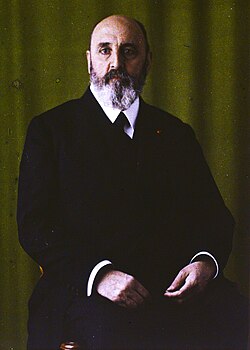
Leonardo Torres Quevedo’s Essays on Automatics (1914) constitute one of the earliest systematic accounts of the theory of automatic and programmable machines, anticipating numerous concepts later developed by cybernetics and computer science.
Self-Regulating System
The second level corresponds to the self-regulating system. The machine incorporates feedback mechanisms that continuously compare the state of the system with a previously defined objective and correct observed deviations. Classical cybernetics is founded on this principle: using information from the environment to maintain the stability of the system.
Hydraulic regulators in Antiquity, Watt’s centrifugal governor, and James Clerk Maxwell’s studies of control systems anticipated this principle, but it was Norbert Wiener who made it the foundation of a new discipline. In Cybernetics (1948), he defined cybernetics as the science of control and communication in animals and machines, placing feedback at the centre of autonomous behaviour.
Today, this level of autonomy is present in virtually all autonomous vehicles. A drone’s flight controller uses gyroscopes, accelerometers, and other inertial sensors to maintain stability through PID controllers and other control algorithms. The machine no longer merely executes a program: it continuously corrects its behaviour according to the information it receives from its environment.
Representational-Anticipatory System
The third level corresponds to the anticipatory-representational system. The machine ceases to react exclusively to the present state of its environment and constructs an internal model on which to base its decisions. From this representation, it estimates trajectories, interprets behaviours, or anticipates events before they occur. Feedback thus ceases to operate solely on observed errors and begins to incorporate probable future states.
Autonomous vehicles and intelligent drones also operate at this level. Cameras, radar, LiDAR sensors, inertial units, GNSS receivers, and SLAM algorithms provide the afferent inputs from which a dynamic representation of the environment is constructed; based on this representation, deep learning models such as Trajectron++, VectorNet, or Wayformer predict the evolution of pedestrians, vehicles, and other moving obstacles. The agent no longer waits for danger to appear before reacting: it anticipates its evolution and adapts its behaviour accordingly. The machine no longer merely corrects; it also predicts.
In software agents based on large language models (LLMs), this level takes a particularly interesting form. These systems do not construct geometric representations of physical space—as a drone does with its point clouds—but semantic representations of context, tasks, and user intentions. The internal layers of LLMs contain latent structures encoding relationships between concepts, propositions, and purposes, enabling them to anticipate not trajectories through space but lines of reasoning, possible responses, or sequences of interaction. The agent does not merely “know” what it has been told; it infers what is likely to be said next, or what is expected of it in a dialogue. Anticipation thus ceases to be spatial and becomes linguistic, discursive, and pragmatic.
Autopoietic System
This is the most advanced level. Here, the machine not only adapts its behaviour to the environment but can also reorganize aspects of its own structure. This capacity to preserve its internal organization by modifying its own components is known in biology as autopoiesis.
The concept was formulated by Humberto Maturana and Francisco Varela to describe a defining property of living beings: continuously producing and renewing their own components without losing their identity as a system. Here, we use the term in a functional rather than strictly biological sense.
Within cybernetic organisms, a distinction could be made between algorithmic autopoiesis, in which the agent reorganizes its own algorithms, models, strategies, or skills, and a more speculative structural autopoiesis, in which it physically modifies its own architecture by incorporating, replacing, or manufacturing new components. This latter scenario evokes concepts such as von Neumann self-replicating probes and remains, for the time being, an essentially theoretical possibility.
The evolution towards increasingly autonomous and adaptive systems nevertheless raises a question that already concerned the founders of cybernetics. Norbert Wiener warned that increasing machine autonomy requires a parallel development of mechanisms for supervision and control. The greater a system’s ability to make decisions without human intervention, the more difficult it becomes to ensure that its behaviour remains aligned with the objectives for which it was conceived. “A machine with a purpose—he wrote—may develop a purpose of its own and come into conflict with the purposes of human beings.”
Epilogue: The Autonomous Drone as a Paradigm of the Cybernetic Organism
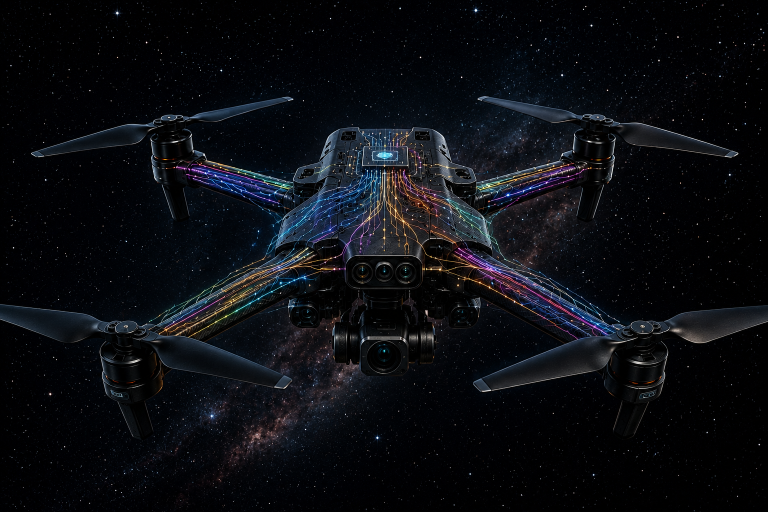
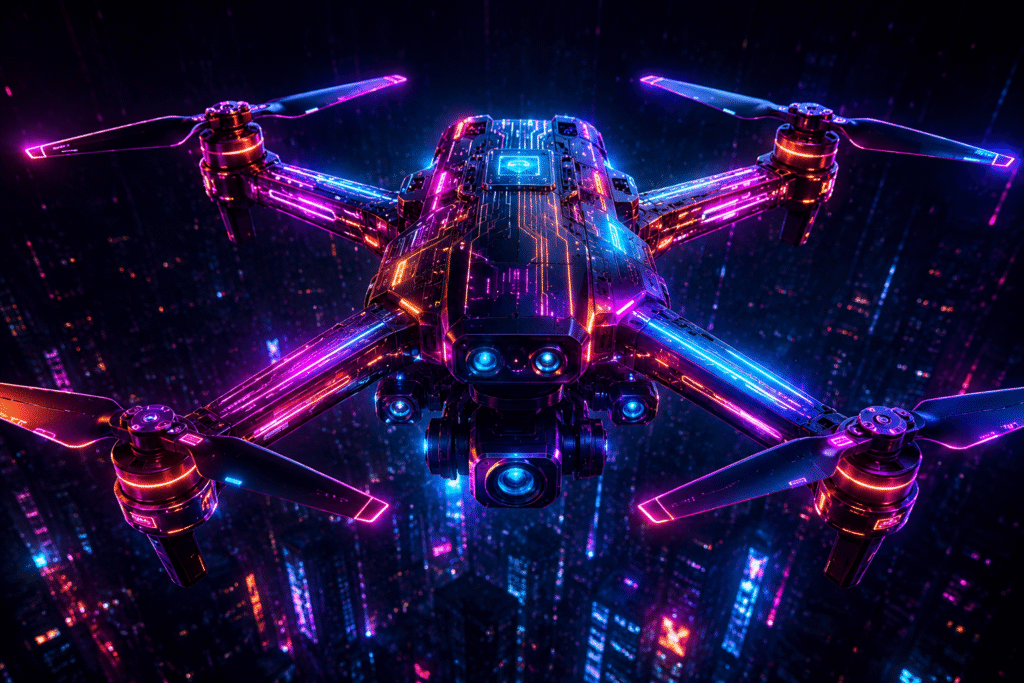
Among all the agents developed to date, few represent the concept of the cybernetic organism better than autonomous drones. They bring together virtually all the principles described in this chapter.
They perceive their environment through cameras, inertial sensors, radar, or LiDAR systems; maintain their stability through classical feedback mechanisms; construct dynamic representations of the space around them; make decisions in real time; and continuously adjust their behaviour according to the consequences of their own actions.
Their intelligence does not reside in an isolated algorithm, but in the coordinated operation of a set of subsystems that maintain a permanent exchange of information with the environment. As in biological organisms, perception, decision, and action form part of a single functional cycle whose purpose is not merely to execute commands, but to preserve the agent’s operability in a changing and uncertain world.
For this reason, drones probably constitute the most complete example of agentic AI currently available. They bring together more than a century of technological evolution: from automatics and classical control theory to deep learning, autonomous robotics, and intelligent navigation systems.
The next article will be devoted precisely to these cybernetic organisms. We will examine their general architecture and study how the integration of sensors, actuators, controllers, and artificial intelligence algorithms makes it possible for a machine not only to move autonomously, but to interact continuously with the world around it.
Recommended Reading
- Torres Quevedo, Leonardo. Essays on Automatics: Its Definition. Theoretical Extension of Its Applications (1914).
- Wiener, Norbert. Cybernetics: Or Control and Communication in the Animal and the Machine (1948).
- Wiener, Norbert. The Human Use of Human Beings: Cybernetics and Society (1950).
- Maturana, Humberto R.; Varela, Francisco J. Autopoiesis and Cognition: The Realization of the Living.
- Ashby, W. Ross. An Introduction to Cybernetics.
SERIES